
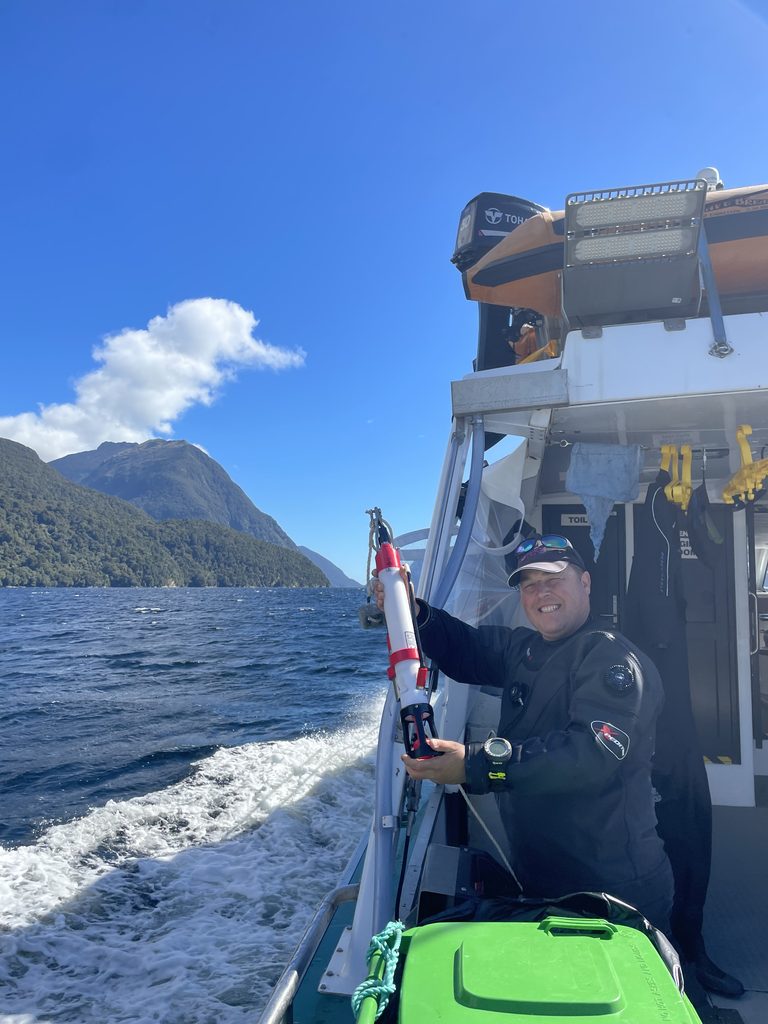
On New Zealand’s South Island’s southwestern edge lies Fiordland: a remote, rain-soaked landscape of towering mountains, temperate rainforest, and deep fjords (or “fiords,” as they have been traditionally called in New Zealand). Despite containing one of New Zealand’s largest carbon sinks, capable of drawing down a comparable amount of carbon dioxide to the country’s annual emissions, it remains among the nation’s least studied regions. Using RBR instrumentation, researchers are now collecting near-monthly observations that are transforming our understanding of these fjords.
How old is that water?
Each winter, physical oceanographer Rob Smith (Senior Lecturer, University of Otago) leads 15–30 postgraduate students into Patea/Doubtful Sound and other fjords in the region to conduct fieldwork investigating environmental change. Every year, while profiling the water in the inner basins, they observe dissolved oxygen dropping sharply below about 100m as the water becomes suboxic. The question the students ask Rob is always the same: How old is that water?
The answer matters because fjords are increasingly recognised as global carbon burial hotspots. Although they cover just 0.1% of Earth’s surface, fjords account for nearly 11% of annual marine carbon sequestration. Deep-water renewal (DWR), in which dense incoming seawater replaces deep basin water, is an important part of the carbon burial picture, influencing dissolved oxygen and therefore preservation of organic carbon in sediments.
Until recently, understanding DWR in Fiordland was limited by infrequent research expeditions. A partnership between the Department of Conservation and the University of Otago changed that with the use of an RBRconcerto3 C.T.D.ODO (CTD profiler with an optical dissolved oxygen sensor) to facilitate the rapid and simple undertaking of near-monthly profiles. The result was an unprecedented dataset – one that has even revealed a new candidate mechanism for deep-water renewal.
A partnership built on simplicity
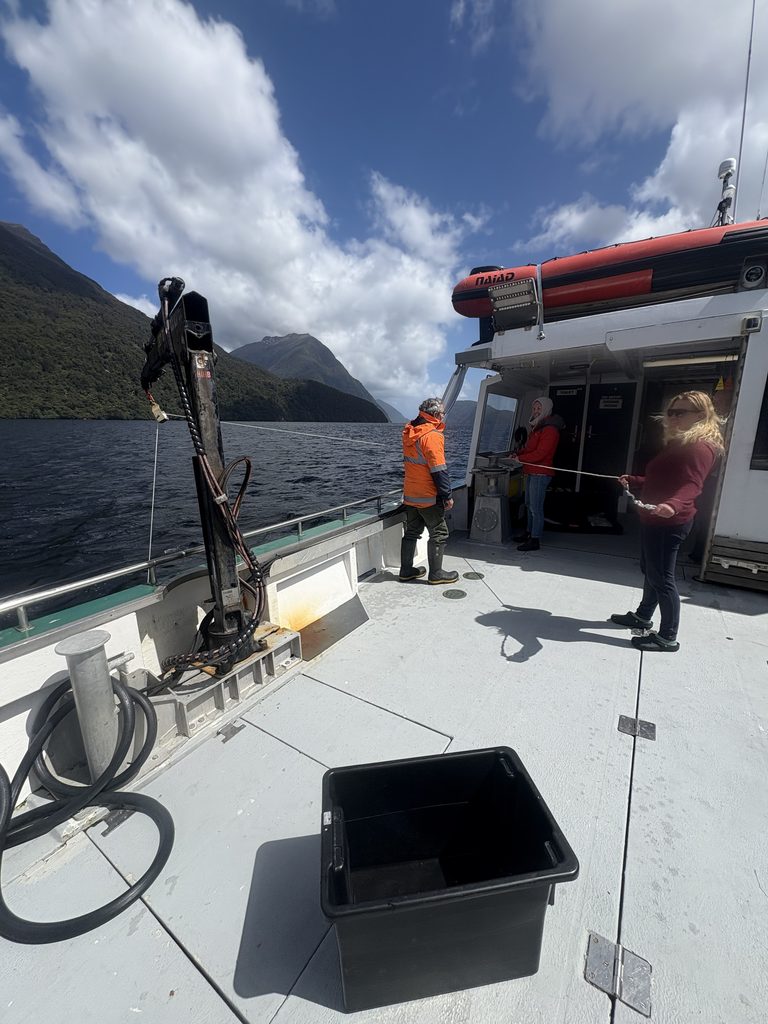
Collecting oceanographic data in Fiordland is challenging. The region’s steep terrain, unpredictable weather, and limited access mean research expeditions are typically conducted only once or twice a year, making it difficult to deduce timescales of variability between visits.
Department of Conservation staff, however, travel throughout Fiordland year-round to support marine science, monitor biodiversity, and conduct conservation programmes in locations where measurements were needed. A partnership could open new monitoring possibilities.
Jackson Beagley, a PhD student under Rob’s supervision, is an engineer who completed a master’s in geophysics before starting his doctoral research. He developed a simple monitoring programme using an RBRconcerto3 C.T.D.ODO. The ease of use of the instrument – across deployment, recovery, and data download – was central to making the collaboration possible.
“Because we already use them in our teaching and research programmes, we knew the calibre of the instruments and how easy they are to operate,” Rob states. In fact, field teams now routinely choose to take only the RBR instrument into the field because it is simpler to deploy and operate than SBE alternatives. Training needs were minimal, too. Jackson recalls how straightforward it was: he only needed to provide a quick how-to guide and a short demonstration for the conservation team to be ready to begin profiling in Fiordland.
Rob is emphatic that the project would not have been feasible without that simplicity: the ability for non-specialists to reliably deploy, recover and download data allowed repeat, research-grade vertical profiles to be collected in the deep fjord basins every one to two months since August 2023, enabling the first direct observations of deep-water renewal in Aotearoa New Zealand’s fjords.
A hidden process comes to light
Since the 1970s, oceanographers have hypothesised about how often deep-water renewal happens in fjords like Patea/Doubtful Sound. Because inferences have historically relied upon annual or semi-annual research expeditions – infrequent snapshots of deep-water conditions – much is still unknown about how (and how often) DWR occurs in Fiordland.
Fjords are typically made up of three layers: a low-salinity surface layer fed by freshwater input, a middle layer that exchanges with coastal ocean waters, and a deep layer that sits below the depth of the sill bounding the fjord basin. It is this deepest layer that is most important for long-term carbon storage as it can become isolated from the ocean for extended periods, leading to oxygen depletion.
Near-monthly CTD profiles built up a detailed picture of conditions in the fjord basins, allowing Jackson and Rob to estimate vertical diffusivity and track changes in water density over time.
Within a few months, Rob was finally able to give his students an answer about just how old that water was. “As soon as we got the first few months of data, it became clear the fjords are renewed each year,” Rob recalls. “The basins are not filled with very old water.” With the water flowing into the fjord at sill depth being denser than the existing deep-water, it signalled that full deep-water renewal had occurred. This occurs every winter.
The observations also revealed how renewal occurs, a key focus of Jackson’s research.
In most deep-silled fjords around the world, this deep-water is refreshed when upwelling brings dense, oxygen-rich water over the entrance sill, flushing and re-oxygenating the basin. Between renewal events, weak vertical mixing gradually alters deep-water density and sets the timing for the next exchange.
Patea/Doubtful Sound behaves differently. With no continental shelf and a very steep drop to over 4km depth within a short distance offshore, it is more directly connected to the Southern Ocean and exposed to strong westerly winds. Based on the data collected, Jackson believes that these conditions allow deep and cool winter mixed layers to form offshore, producing dense water that can enter fjord basins and renew their deep basins.
Jackson and Rob believe it could be a candidate mechanism for unstudied fjords in similar latitude bounds around the world.
“The partnership has enabled a completely new physical understanding of these systems,” Rob continues: “It’s not just that they renew each year, but that they renew through a physical process that wasn’t known in the literature. It gives us pause for thought in terms of understanding the carbon burial process in these fjords.”
Because annual renewal controls how much oxygen reaches the deep basins, influencing how organic material decomposes and how much carbon remains locked away in the sediments, this discovery has important implications for understanding carbon burial in Fiordland.
Building predictive capacity
The dataset collected in collaboration with the Department of Conservation continues to underpin Jackson’s research. He is now working to characterise additional factors that influence the system, such as the impact of freshwater discharge from the Manapōuri Power Station.
Ultimately, the team’s hope is to build a hydrodynamic model of Patea/Doubtful Sound – one that can help scientists and policymakers understand how resilient Fiordland’s natural carbon sink is and predict how it might respond as rainfall, freshwater input, oceanic conditions, and climatic factors change.
“Those repeat CTD casts are invaluable,” Rob concludes. “Not only have they allowed us to make new scientific discoveries in these fjords, but they’ve also given us the ability to build and validate predictive models. The supporting role that they then play to let us set up and confidently use these models is great.”
Rob and Jackson’s hydrodynamic work forms part of a larger, five-year NZ$8.6 million project “Natural carbon sequestration in our southern fjords – a pathway towards carbon neutrality,” which is funded by the MBIE Endeavour Research Programme fund in New Zealand and has recently received an additional year of funding, starting September 2026.
The project is led by the University of Otago and Earth Sciences New Zealand (formerly GNS Science), in a collaborative effort between Te Rūnanga o Ngāi Tahu, Fiordland Marine Guardians, and a team of New Zealand and international scientists.
Learn more
- Beagley, J. E., C. M. Moy, G. S. Wilson, G. E. Arnaud, R. Kinsey, C. R. Riesselman, and R. O. Smith (2026), Characteristics and drivers of deep water properties in a temperate fjord in Aotearoa/New Zealand, J. Geophys. Res.: Oceans, 131, e2025JC023541, Characteristics and Drivers of Deep Water Properties in a Temperate Fjord in Aotearoa/New Zealand .
- Carbon sequestration in New Zealand’s southern fjords
- RBRconcerto C.T.D multi-channel instruments