
RBRduo3 and RBRconcerto3: C.T, C.T.D, C.T.D++
Our flexible, option-packed loggers dedicated to salinity and more.
- 240M readings
- Standard sampling of 2Hz
- Up to 32Hz sampling
- USB-C download
- Realtime communications
- Twist activation
- Wi-Fi enabled
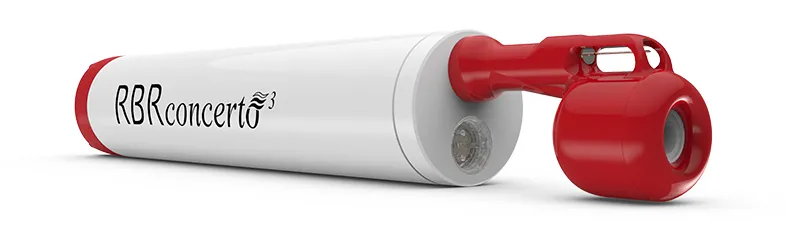
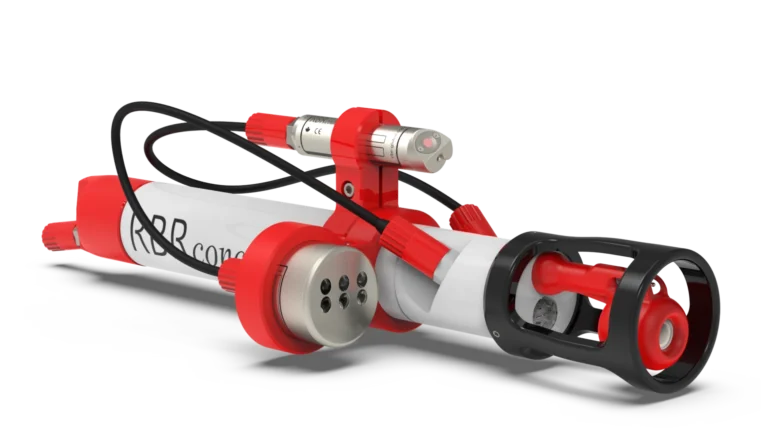
- C.T
- C.T.D
- C.T.D+
- C.T.D++
Features & Configurations
RBRduo³ C.T and RBRconcerto³ C.T.D
The RBRduo³ C.T and RBRconcerto³ C.T.D are built on the years of experience RBR has creating reliable and easy-to-use instruments. They are uniquely designed to determine salinity by measuring the conductivity and temperature of water. Equipped with a pressure channel, the RBRconcerto³ C.T.D can also derive depth, density anomaly, and speed of sound. These self-contained, accurate, and autonomous submersible instruments can be deployed for a period of up to five years at 1min sampling intervals, and the data is retained in memory even after the batteries are removed.
Salinity
Conductivity measurements are performed using a rugged inductive cell suitable for deployment in marine, estuarine, or fresh water. There are no exposed contacts, which avoids susceptibility to corrosion, and the housing may be frozen into ice without damage. It is characterized for the mechanical effects of both temperature and pressure to allow for accurate correction in salinity derivation. These coefficients are provided for customers who prefer to calculate their own corrections. In addition, it is suitable for use outside the usual realms of PSS-78 practical salinity scale, in applications such as desalination brine monitoring. The conductivity readings are temperature-corrected.
For profiling applications, the co-located thermistor reduces salinity spiking, thus increasing data accuracy.
Equipped with a piezoresistive pressure channel, the CTD instruments provide more accurate salinity data when the instrument is sampling at varying depths.
Additional sensors
A diversity of sensor configurations allows the instrument to be fine-tuned for a wide variety of applications. Variants with pressure, temperature, conductivity, radiometer, PAR, and turbidity sensors are also available in titanium housing, designed to endure harsh conditions.
Optional configurations
- Wi-Fi communication
- External data and power connection via connectorised end-caps
- | fast8, | fast16, or | fast32 sampling for profiling
- | tide16, | wave16 variants with wave burst and tidal averaging
- | deep variants in titanium housing for depths up to 6000m
Specifications
| Storage | 240M readings |
|---|---|
| PowerFootnote 1 | 8 AA cells |
| External power | 4.5 to 30V |
| Communication | USB-C or RS-232/485 |
| Clock drift | ±60 seconds/year |
| Housing | Plastic or titanium |
| Diameter | 63.3mm (plastic), 60.3mm (Ti) |
| Length | Configuration dependent |
| Weight | Configuration dependent |
| Depth ratingFootnote 2 | Up to 6000m (configuration dependent) |
| Sampling rate | 2Hz; options up to 32Hz |
1 Lithium thionyl chloride batteries are only recommended for the RBRduo³ C.T and RBRconcerto³ C.T.D. Use alkaline or lithium iron batteries for all other configurations.
2 The depth rating for RBRconcerto³ Tx may be up to 8000m.
| Range | 0-85mS/cm |
|---|---|
| Initial accuracy | ±0.003mS/cm |
| Typical stability | 0.010mS/cm/year |
| Resolution | 0.0001mS/cm |
| RangeFootnote 3 | -5°C to 35°C |
|---|---|
| Initial accuracy | ±0.002°C |
| Resolution | <0.00005°C |
| Time constant | <0.1s | fast, <1s standard |
| Typical stability | 0.002°C/year |
3 A wider temperature range is available upon request. Contact RBR for more information.
| RangeFootnote 4 | 20 / 50 / 100 / 200 / 500 / 750dbar (plastic) 1000 / 2000 / 4000 / 6000dbar (Ti) |
|---|---|
| Initial accuracy | ±0.05% full scale |
| Resolution | <0.001% full scale |
| Time constant | <0.01s |
| Typical stability | ±0.05% full scale per year |
4 Recommended depth for wave measurements is less than 50m.
| Wavelength | 880nm |
|---|---|
| Centroid angle | 90° |
| Linearity, R | 0.99 |
| Initial accuracy | 5% |
| Calibrated range | 0 – 1000FTU |
| Measurement rangeFootnote * | 0 – 1500FTU |
| Detection limit | 0.005FTU |
* Response becomes non-linear above 1000FTU.
| Wavelength | 880nm |
|---|---|
| Centroid angle | 135° |
| Linearity, R² | 0.99 |
| Initial accuracy | 5% |
| Calibrated range | 1000-4000FTU |
| Measurement rangeFootnote* | 0 – 20000FTU |
| Detection limit | 2.0FTU |
* Response becomes non-linear below 500FTU and above 15000FTU.
| Wavelength | 470nm/695nm (excitation/emission) |
|---|---|
| Calibrated rangeFootnote* | 0-50µg/L |
| Measurement range | 0-500µg/L |
| Detection limitFootnote* | 0.02µg/L |
* Scaled for the in vivo fluorescence response.
| Linearity, R | 0.99 |
|---|---|
| Initial accuracy | 5% |
| Calibrated range | 0-500μM concentration 0 – 120% saturation 1.5°C to 30°C temperature |
|---|---|
| Initial accuracy | Maximum of ±2μmol/L or ±1.5% Maximum of ±8μmol/L or ±5% | fast Maximum of ±2μmol/L or ±1.5% | slow |
| Resolution | <0.5μmol/L (saturation 0.2%) <1µmol/L (saturation 0.4%) | fast <0.1μmol/L (saturation 0.04%) | slow |
| Time constant | <8s standard, <1s | fast, <30s | slow |
| Sampling rates | 24hr to 1Hz |
Output values
- Temperature (°C)
- Dissolved O2 concentration (μmol/L)
- Dissolved O2 concentration (salinity compensated, μmol/L)
- Dissolved O2 saturation (%)
- Dissolved O2 phase (°)
Contact RBR for other sensor options.
We partner with passionate oceanography and water quality experts worldwide to ensure you receive excellent local customer service, sales, and support.