
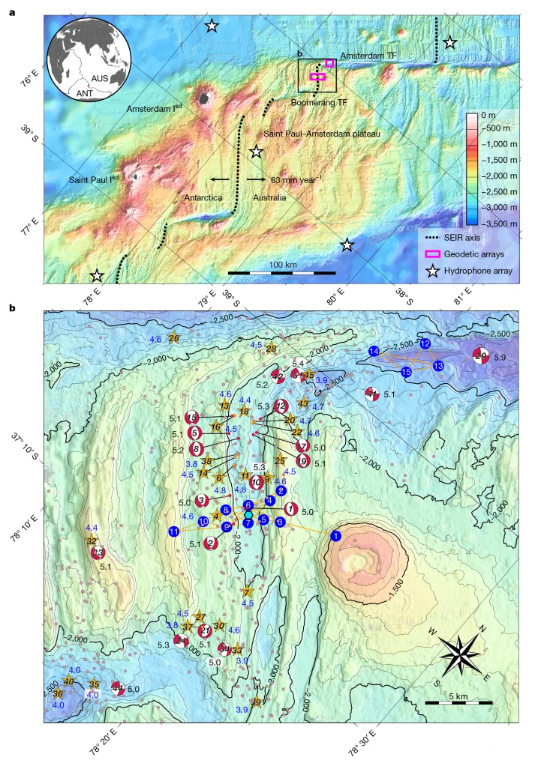
Deep on the Southeast Indian Ridge, about 37° S, the seafloor recently did something rarely observed up close: it ripped apart. A study published in Nature on 8 July 2026 by Jean-Yves Royer and colleagues describes a rifting event that began on 26 April 2024, just two months after the team had deployed a network of instruments across the ridge axis and the nearby Amsterdam transform fault.
At the heart of the monitoring setup sat an RBR bottom-pressure recorder (BPR) with AzeroA drift correction, placed directly on the floor of the axial valley to track its vertical movement with high precision. As a swarm of seismicity swept along the valley, the BPR recorded 4m of seafloor subsidence, evidence that a sill-like magma reservoir below was deflating as it fed dykes propagating along the ridge. Over the following 16 days, that magma reached the surface, releasing around 160 million m³ of lava.
The result is one of the clearest in situ records yet of how mid-ocean ridges grow, and a reminder of why precise, drift-controlled pressure measurement matters in some of the planet’s most remote and consequential places.
Read the full study: Nature, 8 July 2026 (CC BY 4.0)